
Gameplay
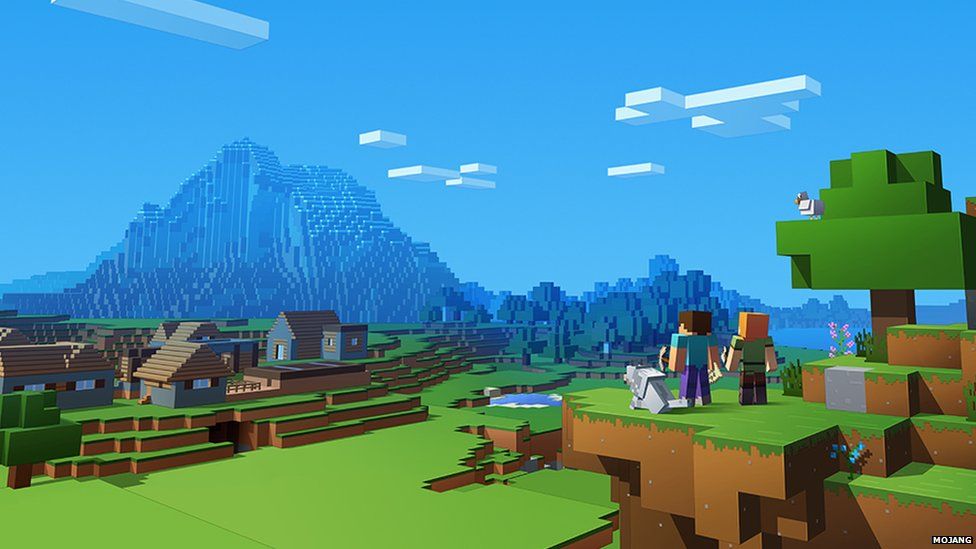
Minecraft is a 3D sandbox game with no goals required to
achieve, allowing players a great deal of freedom in choosing a game mode. However,
there is a system of success, known as "progress" in the Java Edition
of the game, and "trophies" in the holes of the PlayStation. Game
play is in first-person mode automatically, but players have a third-party
viewing option. The game world is made up of rough 3D objects — mainly cubes
and liquids, often referred to as “blocks” —represents various materials, such
as dirt, stone, metal, tree trunks, water, and mud. The main game revolves
around picking up and storing these items. These blocks are arranged in a 3D
grid, while players can move freely around the world. Players "mine"
the blocks and place them elsewhere, enabling them to build objects. Many
commentators have described the game's physics system as unrealistic. The game
also contains a substance known as redstone, which can be used to make classic
machines, electrical circuits, and sensible gates, allowing for the
construction of many complex systems.
The game world is virtually unlimited and is processed as players
test it, using map seeds found in the system clock during the creation of the
world (or specify the player personally). There are limits to direct movement,
but Minecraft allows an infinitely large gaming world to be made on a
horizontal plane. Due to technical problems when remote locations are reached,
however, there is an obstacle preventing players from moving beyond more than
30,000,000 blocks from the center. [H] when players are close. The land is
divided into biomes from deserts to forests to glaciers; this area includes
plains, mountains, forests, caves, and various lava / water areas. The in-game
time system follows a day and night cycle, and one full cycle lasts 20 minutes
of real time.
When starting a new world, players must choose one of five
game modes, as well as four difficulty, from quiet to strong. Increasing the
difficulty of the game causes the player to take a lot of damage to the crowds,
as well as having other difficulty-related effects. For example, peaceful
weights prevent hateful masses from giving birth, and heavy weights allow
athletes to starve to death if their appetite decreases. Once selected, the
difficulty can be changed, but game mode is locked and can only be changed by
cheats.
New players have a randomly selected character skin by Steve
or Alex, but the option to create custom skins was made available in 2010.
Players encounter a variety of characters that are not players known as crowds,
such as animals, citizens, and hostile creatures. Idle crowds, such as cattle,
pigs, and chickens, may be hunted for food and building materials. They breed
during the day, while hostile crowds — including giant spiders, skeletons, and
zombies — breed at night or in dark places such as caves. Some hostile crowds,
such as zombies, skeletons and swallows (subterranean zombies), burn under the
sun when they have no hats on their heads. Other unique creatures in Minecraft
include the creeper (an explosive creature that steals a player) and the
enderman (a creature with the ability to telephon and pick up and place
blocks). There are also a variety of crowds breeding in different conditions;
for example, zombies have a variety of shells that reproduce in the desert.
Minecraft has two distinct types besides overworld
(mainland): Nether and End. Nether is a hell-like size accessible through
player-created sites; contains many unique resources and can be used to travel
long distances on the surface of the earth, thanks to the total number of
blockbuster in the Nether equals 8 blocks around the world. The player can
create a host of his or her own choice called Wither without the elements found
in the Nether. End is a barren land with many islands floating on top of a
dark, endless space. A giant dragon called the Ender Dragon lives on a large
island. Killing a dragon opens access to the exit portal, which when it enters
shows the end-of-game credits and a poem written by Irish author Julian Gough.
Players are then telephoned and relocated and can continue the game
permanently.
Game modes

Survival mode
In survival mode, players must collect natural resources
such as wood and locally available stones to build blocks and objects.
Depending on the difficulty, the animals breed in dark areas outside the
character's area, which requires their players to build a shelter at night. The
mode also has a health line that is reduced by crowd attacks, falls, drownings,
mudslides, congestion, starvation, and other events. Athletes also have an
appetite for hunger, which should be replenished from time to time by eating
in-game meals, except in peaceful conditions. When hunger is over, automatic
healing will stop and eventually life will end. Life is fuller when players
have a hunger bar that is almost full or continuous in peaceful situations.
Players can do a variety of things in Minecraft.
Considerations include weapons, which reduce the damage to the attack; weapons
(such as swords or axes), which allow animals and animals to be easily killed;
and tools, which break certain types of blocks very quickly. Some items have
many categories depending on the materials used to make them, and the high
quality materials that work well and last a long time. Players can build a
fireplace, which can cook food, grind metal, and convert building materials
into other materials. Players can also exchange goods with a citizen (NPC)
through a trading system, which involves trading emeralds for a variety of
goods and vice versa.
The game has an inventory system, which allows players to
manage a limited amount of items. When they die, items on the player list are
downgraded unless the game is re-configured to do so. Players then reproduce in
their breeding ground, which is automatically the players' first breeding in
the game, and can be reset by lying in bed or using a restarted anchor.
Discarded items can be recovered if players can access them before they
disappear or exit after 5 minutes. Players can earn experience by killing
crowds with other players, digging mines, smelting metal, breeding animals and
cooking food. The experience can be applied to amazing tools, weapons and
armor. Witches are usually more powerful, longer lasting, or have special
effects.

Hardcore mode
Hardcore mode is a type of survival mode locked in the most
difficult and permadeath environment. If a player dies in a solid world, he is
no longer allowed to interact with them, so he can be put in viewer mode and
explore the world or remove it altogether. This game mode can only be accessed
in Java Edition.

Creative mode
n Creative mode, players have access to almost all of the
game's resources and items through the inventory menu, and they can set or
delete them quickly. Players can change the ability to fly freely in the game
world at will, and their characters are harmless and not starving. Game mode
helps players focus on designing and creating projects of any size without
interruption.

Adventure mode
The Adventure Mode was designed specifically so that players
could experience custom-designed and self-paced maps. Playing the game is
similar to survival mode but there are different limits, which can be used in
the game world by map maker. This forces players to find needed items and
experience adventures the way the map maker intended. Some additional
customizable map command commands; this block allows map makers to extend
interaction with players using written server commands.
Spectator mode
Spectator mode allows players to fly through blocks and
watch a game without direct contact. Players do not have inventory, but they
can telephonize other players and view them from the perspective of another
player or creature. This game mode can only be accessed within Java Edition and
Console Legacy Editions.

Multiplayer
Multiplayer in Minecraft enables multiple players to
interact and connect in one world. Available with real multiplayer game, LAN
playback, local partition screen (console only), and servers (player and
business hosting). Players can use their own servers, use a hosting provider,
or connect directly to another player's game via Xbox Live. One-player world
has local network support, allowing players to join the world on computers
connected locally without server setting. Minecraft multiplayer servers are led
by server operators, who have access to server commands such as setting the
time of day and teleporting players. Users can also set restrictions on which
usernames or IP addresses are allowed or disallowed on the server. Multiplayer
servers have many different functions, and some servers have their own different
rules and cultures. The largest and most popular server is Hypixel, with over
14 million unique players. Player-to-player combat (PvP) may be allowed to
allow for combat between players. Many servers have custom plugins that allow for
unusual actions.
Minecraft Realms
In 2013, Mojang announced Minecraft Realms, a server hosting
service designed to enable players to run multiplayer server games easily and
securely without having to set up their own. Unlike a standard server, only
invited players can join Realms servers, and these servers do not use IP
addresses. Minecraft: Java Realms Edition server owners can invite up to 20
people to play on their server, with up to ten players online at a time.
Minecraft Realms server owners can invite up to 3000 people to play on their
server, with up to 10 players online at one time. Minecraft Servers: Java
Edition Realms does not support user-made plugins, but players can play custom
Minecraft maps. Minecraft Realms servers support user-added add-ons, resource
packs, behavioral packs, and customized Minecraft maps. At Electronic
Entertainment Expo 2016, cross-platform playback support between Windows 10,
iOS, and Android platforms has been added by Realms since June 2016, with
support for Xbox One and Nintendo Switch to come later in -2017, and support
for virtual reality devices. On July 31, 2017, Mojang released a beta version
of the update that allows for a different playground. Nintendo Switch support
for Realms was released in July 2018.
Customization
The repair community consists of fans, users and programmers
of third-party programs. Using a combination of various applications that have
evolved over time, they have produced a variety of Minecraft downloadable
content, such as refinement, texture packs and custom maps. Minecraft code
modification, called mods, adds a variety of game modifications, from new
blocks, new items, new crowds to all sorts of modes. The editing community is
responsible for providing a wide range of models from those that improve game
play, such as mini maps, waypoints, and solid counters, to those that add game
features from other video and media games. While a variety of modes were
developed independently by the reversal of the engineering code, Mojang also
developed vanilla Minecraft with official modifications, which allow for the
production of community-created resource packs, altering certain game features
including texture and sound. Players can also create their own "maps"
(custom world files) that often contain specific rules, challenges, puzzles and
requirements, and share them for others to play. Mojang added the fun mode for
August 2012 and the "command barriers" in October 2012, specially
designed for custom maps in Java Edition. The data packets, introduced in
version 1.13 of the Java Version, allow for more customization, including the
ability to add new developments, sizes, functions, loading tables, predictions,
recipes, properties, tags, global generation settings, and biomes.
Xbox 360 Edition supports downloadable content, available
for purchase through the Xbox Games Store; these content packs usually contain
additional character skins. She later found support for texture packs in her
review of the twelfth theme while introducing "mash-up packs", which
include texture packs and leather packs as well as changes in game audio, music
and user visibility. The first mash-up package (and in addition, the first
sewing package) for the Xbox 360 Edition was released on September 4, 2013, and
featured the theme behind the Mass Effect franchise. Unlike Java Edition,
however, the Xbox 360 Edition does not support customized player modes or maps.
A multi-service package based on Nintendo's Super Mario Franchise was released
for the Wii U Edition worldwide on May 17, 2016. The Fallout-based mash-up
package has been announced for release in the Wii U Edition. In April 2018, a
non-computer program was acquired on a few user-friendly Minecraft skin for use
with the Java Edition of the game. Avast has estimated that about 50,000
accounts have been infected, and when activated, a malicious program may
attempt to format the user's database. Mojang quickly corrected the problem,
and issued a statement saying "the code will not be used or read by the
game itself", and will only work when the image containing the skin itself
is opened.
In June 2017, Mojang released an update known as the
"Discovery Update" in Bedrock's version of the game. The update
includes a new map, a new game mode, "Market Place", a catalog of
user-generated content that gives Minecraft creators "another way to earn
a living", and more.


1 Comments
Nice
ReplyDelete